A tech pack template is the layout for the document your factory makes a sample from. You know a filled-in one is done when your factory could make the first sample without emailing you a single question. Factories can't read your mind.
What goes in a tech pack?
Five parts, each answering one question the factory would otherwise ask you:
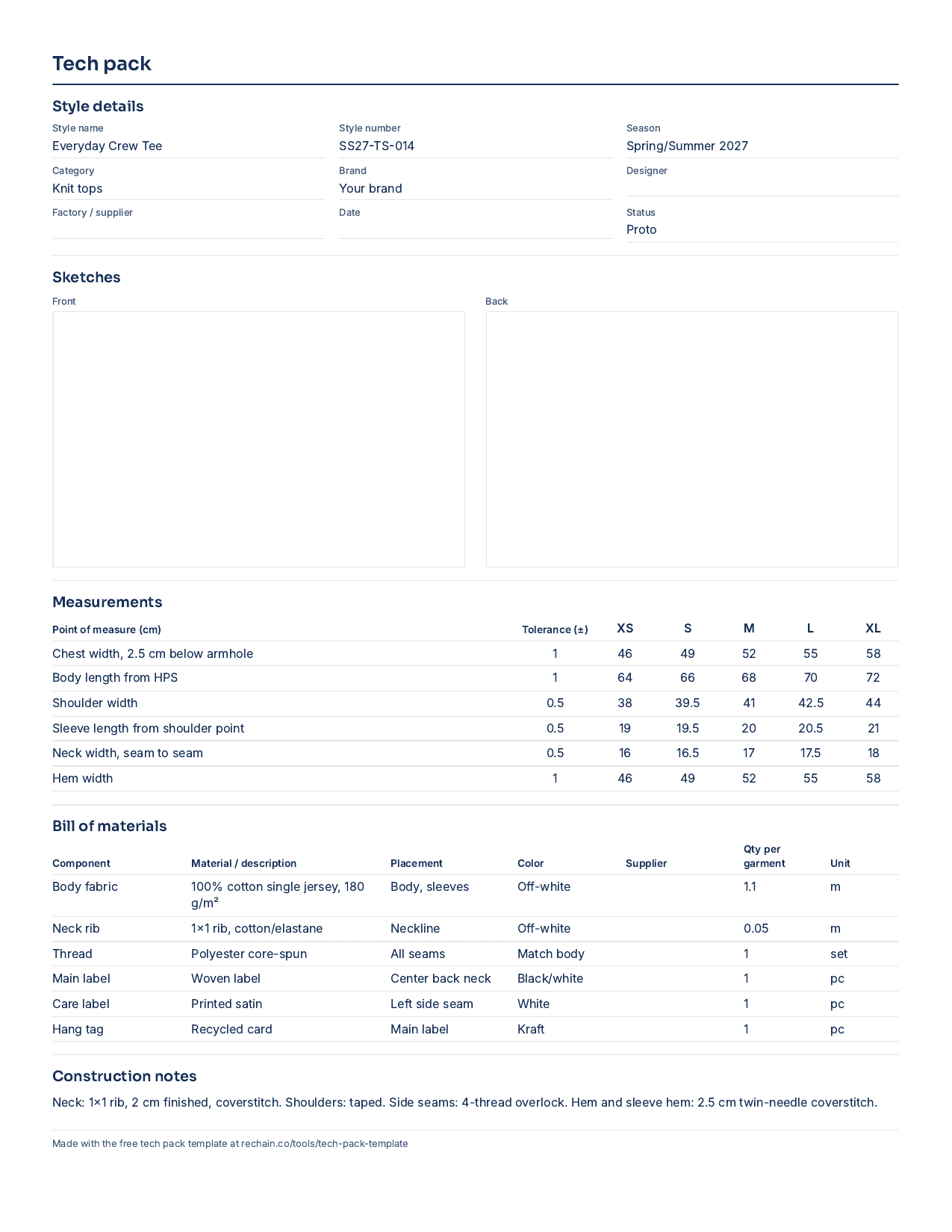
- Style details: which style is this, and which sample round? Style number, season and status (proto, fit sample, pre-production or production).
- Sketches: what does it look like? Front and back flats.
- Measurements: how big is each point, in every size, and how far off can it be?
- Bill of materials: what is it made of, where does each material go, in what color, and how much per garment?
- Construction notes: how is it sewn? Seam and stitch types, finished widths.
Our guide to tech packs goes deeper on what a tech pack includes.
How do you fill in the measurements?
Each row is a point of measure: a named place on the garment, measured the same way every time. Name it so two people get the same number. “Chest width, 2.5 cm below armhole” works. “Chest” doesn't. Then give each size its number, and a tolerance: how far a sample may be off and still pass. The step from one size to the next is the grade.
In the example, the chest is 52 cm at M and moves 3 cm per size, from 46 cm at XS to 58 cm at XL. With a ±1 cm tolerance, an M fit sample passes anywhere from 51 to 53 cm. At 53.5 cm it goes back with a comment. Because the sizes sit 3 cm apart and the tolerance is 1 cm, the passing ranges never overlap: no sample can measure as both an M and an L.
Chest width per size, with the ±1 cm a sample may be off
What should the bill of materials list?
One row per material, down to the thread, the labels and the hang tag. For each one: what it is, where it goes, its color with a code such as a Pantone number, its supplier if you've chosen one, and the quantity per garment with a unit, like 1.1 m of fabric or 1 care label. The factory prices the style from those quantities. Leave them out and your quote is built on the factory's guess.
What format should a tech pack be in?
A PDF. Set the status to the sample round you're on, so every comment that comes back points to one version.
Your sketches never leave your computer: the template runs in your browser. The page's URL saves your text and tables but not the sketches, so keep the PDF as your record.
When does a template stop being enough?
For one style and one factory, a PDF is fine. It breaks when you run a season of styles with several suppliers. Every change becomes a new file and a new email, and sooner or later one wrong tech pack version gets sent to a factory.
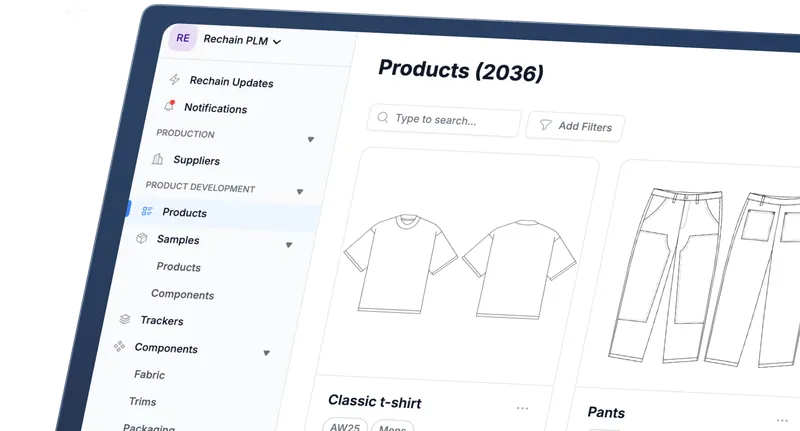
That's when a PLM pays for itself. In Rechain, the tech pack, the sample comments and the materials you reuse across styles live in one place, and suppliers work in it with free accounts. Destira cut its tech pack creation time by 80% with Rechain. Here's how tech packs work in Rechain.