Wildling Shoes has been redefining footwear since 2015. Founded in Engelskirchen, Germany, the certified B Corp produces minimalist shoes from ethically sourced natural materials: North German wool, organic cotton, hemp, and responsibly sourced deer leather. With nearly 300 employees working remote-first across Germany and production spanning multiple countries, Wildling operates one of the most intentionally complex supply chains in the footwear industry.
That complexity was the problem. Before Rechain, Wildling's product team managed collection data across a sprawl of disconnected Excel spreadsheets. One set tracked product development. Another had to be manually rebuilt for the purchasing team. Yet another was assembled for the customer-facing teams and the web shop. The supply chain management team, working with Retraced to trace sourcing and production, relied on the same fragmented data.
The same data lived in multiple places, and nobody could be sure which version was current. Errors crept in. Handovers between teams consumed hours of manual checking. Last-minute changes to a collection meant hunting across files to make sure nothing was missed.
Wildling knew they needed a PLM solution, but their requirements were unusually demanding. The brand sources raw materials directly (sometimes the actual fleece or fibre, not finished components) and enforces strict standards around animal welfare, fair labour practices, and environmental impact. Off-the-shelf PLM tools built for conventional buy-and-resell brands couldn't accommodate these workflows.
After evaluating multiple providers, Wildling chose Rechain for its ability to customise and adapt to their highly individual sourcing and development processes. Rechain was not just a tool for brands that buy and resell; it could handle the full depth of component development and material traceability that Wildling required.
We had a very chaotic data structure. Different Excel sheets needed to be transferred into other Excel sheets for different teams. A lot of mistakes happened because we had to update the same data in multiple places, and nobody really knew if every sheet was up to date.
Anna Funke-Schütz
The onboarding began during a period of significant internal change at Wildling: a company-wide restructure that reshaped the product team. Implementing a new PLM system while the organisation was being redesigned could have been destabilising. Instead, the Rechain team turned it into a collaborative process.
For Anna Funke-Schütz, Wildling's Product Manager, this was her first time working with a PLM tool. Rather than providing documentation and walking away, Rechain's team operated as embedded partners, answering questions, suggesting best practices, and helping the team understand not just how to use the tool, but how to think about structuring product data for long-term clarity.
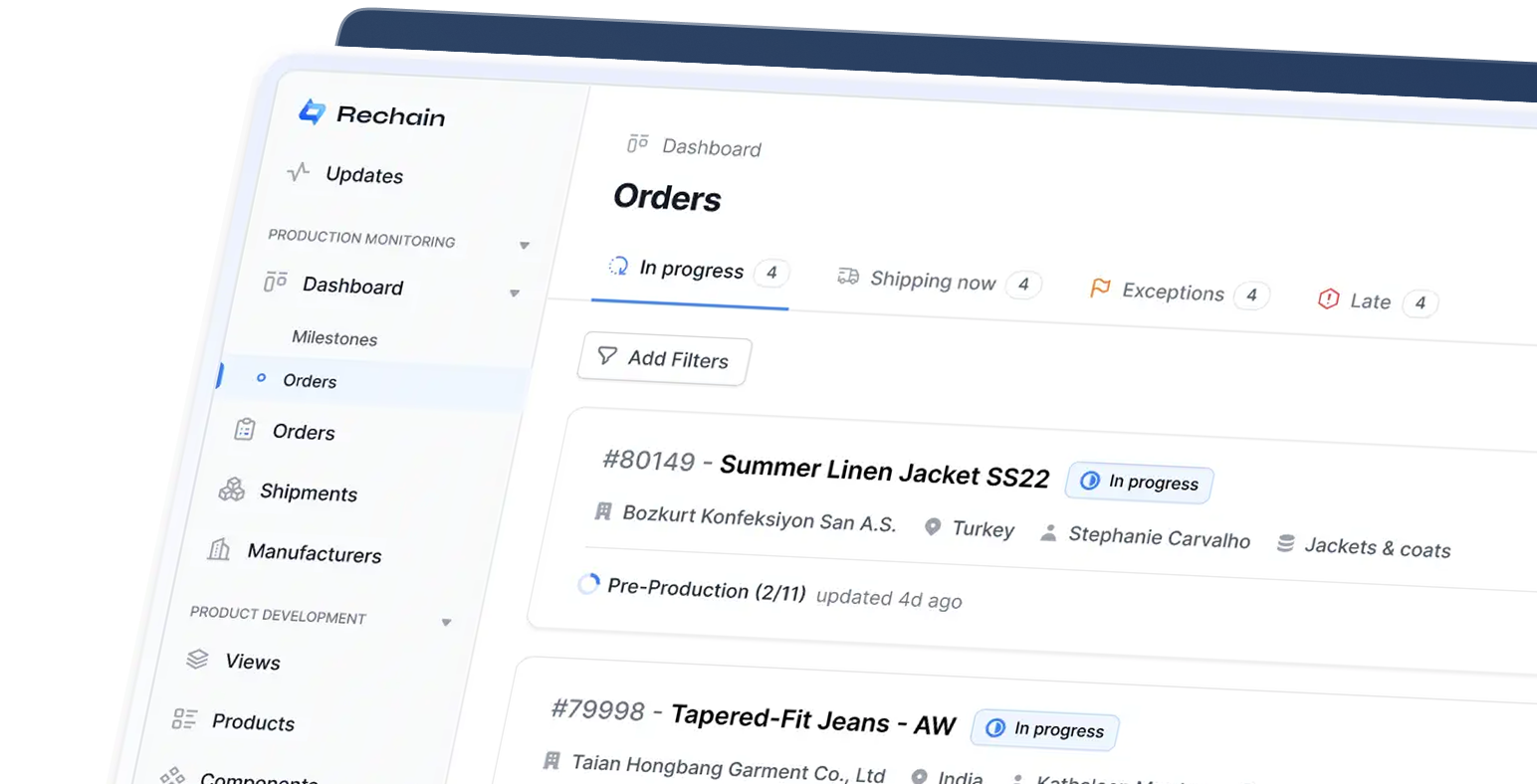
The central transformation was moving from fragmented spreadsheets to a single, unified data platform. Every product style, material specification, trim detail, and sampling update now lives in Rechain. Collection reports that once required hours of manual assembly can now be generated in minutes. Fields can be toggled on or off depending on what each downstream team needs, and the data is always current.
During onboarding, Wildling shifted part of its production to a new country, introducing entirely different trim and material sourcing processes. The Rechain team adapted the system in real time, maintaining the customised structure built for Portuguese production while accommodating the new workflows.
It was everything new and a complete new learning journey. It was really nice because I felt like I could ask, 'What would be the best solution here?' This helped the whole team get into working with the PLM tool and really understand the benefits.
Anna Funke-Schütz
The most measurable impact has been on the collection launch process. Before Rechain, handing over product data to customer-facing teams and the web shop required several hours of manual work: cross-checking data across multiple spreadsheets, verifying accuracy, and reformatting for each audience. That process now takes approximately one and a half hours, a reduction of roughly 75%.
Beyond the time savings, last-minute changes are now stored in a single place and immediately accessible to any team or supplier. Supplier communication around sampling, previously scattered across email, Slack, and WhatsApp, is now centralised in Rechain. The designers have developed a fluid, collaborative workflow, and the entire product team is aligned on a shared process.
Looking ahead, Wildling plans to build out Rechain's dashboard capabilities and continue refining their data. The Retraced integration, syncing supply chain traceability data with product data, is now operational, closing the loop on one of Wildling's core requirements.
Everything is now stored in only one place and can be handed over at any time to any team or supplier who needs this information. We're minimising the time we spend on handover processes; it's so much quicker. And whenever something pops up, we can just contact you on the chat and you're scheduling a call pretty much in the same moment.
Anna Funke-Schütz
Boost your productivity. Start using Rechain PLM today
Get a personalized demo and see how Rechain PLM can help you manage your product development and production processes.