.avif)
Vitality has built one of the fastest-growing inclusive athleisure brands in the United States. Founded in 2018 in Denver, Colorado, the family-owned company designs and manufactures activewear in sizes XXS to 4XL, with custom-developed fabrics and a fiercely loyal community. Named to Forbes' "30 Under 30" list, the brand has expanded rapidly, but with a lean product team, every tool needs to earn its place.
The team is small by design. Alexa Cowen, Director of Product, manages everything from design handoff through production, including fabric development, supplier coordination, sampling, marketing handover, and costing. Esther, VP of Design, drives the creative direction. With no one reporting into them, both handle every detail themselves. In that environment, a complicated PLM isn't an inconvenience; it's a direct hit to output.
Vitality's previous PLM looked promising in the demo but failed to deliver. The vendor promised the team would be live within a few months of signing in October. Instead, onboarding dragged until May or June, roughly double the expected timeline.
When the system finally went live, the reality didn't match the sales pitch. Adding a simple colour required manually entering hex codes with no linked references. Opening a style meant right-clicking through obscure dropdown menus. Nothing was connected. Every small action took multiple unintuitive steps.
The team repeatedly asked for changes, but the vendor pushed back, insisting the build matched specifications. For a two-person product team already stretched thin, the PLM was consuming time rather than saving it.
It was so complicated. There was no rhyme or reason why it needed to be that complicated. It seemed to be taking away time from us instead of gaining time on our side.

Alexa Cowen
Both members of Vitality's product team came from larger companies (Free People, Guess Jeans, and Nike) where they'd used enterprise PLM systems like Bamboo Rose. They knew simpler, more effective tools existed. The challenge was finding one that could serve a small team without enterprise price tags and minimum-user requirements.
Esther discovered Rechain during her research, drawn to the clean interface and existing customer base. Rechain's team transferred Vitality's existing data and had them operational within two weeks, a stark contrast to the six-month ordeal with the previous vendor.
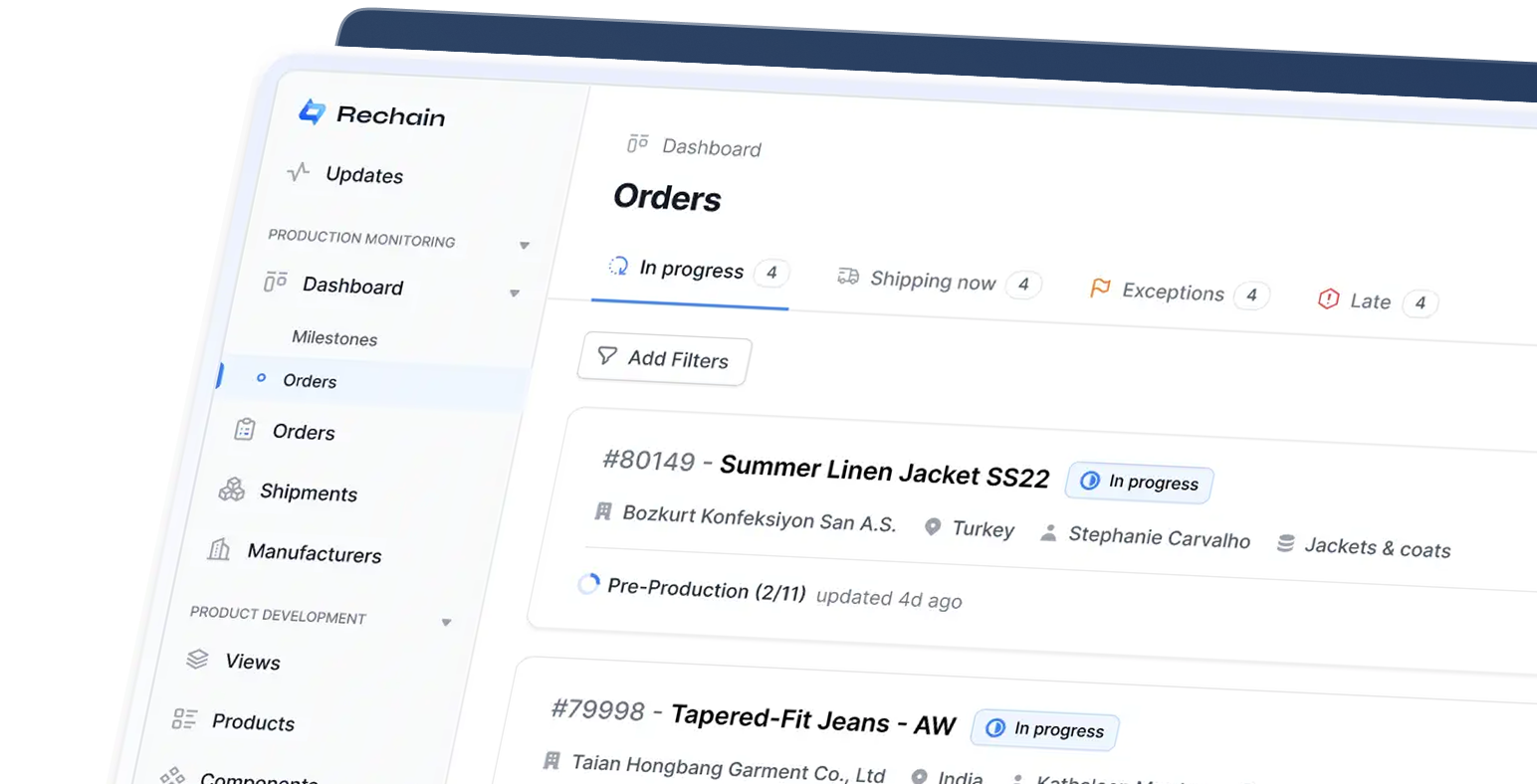
The product development lead's benchmark for any PLM is straightforward: you should be able to figure out most things on your own. With Rechain, the interface matched what was shown in the demo: simple navigation, logical workflows, and connected data. Styles, approvals, lab dips, fabric information, and BOMs all live in one organised place. Costing calculations, including IMU percentages, are built directly into the system.
Critically, when Vitality raises feedback or feature requests, the changes actually happen. The IMU percentage calculation was one such request: the team asked for it, and it was implemented. That responsiveness, combined with fast support even across time zones, has built genuine trust.
Everything that we've been asking for, things that have come up, have been dealt with or implemented. You guys are taking our feedback, and it actually happens, which is super exciting.
Alexa Cowen
The shift from the previous PLM to Rechain removed friction at every level of Vitality's product development workflow. Tasks that previously required searching through Slack messages (downloading size charts, checking approved lab dips, referencing fit notes) now take seconds in Rechain. BOM updates, costing reviews, and approval tracking are all streamlined into a single organised system.
Supplier collaboration has also improved, with factories working directly in Rechain for approvals and sampling. The team is already planning to onboard two additional factory partners and bring purchase orders into the platform as they grow more comfortable with the system.
It's just nice to have everything organised. I'm requesting lab dips in there, my fabric information is all in there, all my approvals are in there, and now the costing aspect too. Instead of me having to search through Slack, it takes one second. It's been super simple and great.
Alexa Cowen
Boost your productivity. Start using Rechain PLM today
Get a personalized demo and see how Rechain PLM can help you manage your product development and production processes.