Inside This Report

Fashion PLM Migration: How Long It Takes and Who Does It

Matthias Richard
November 26, 2026
5 min read

TL;DR:

Switching fashion PLM takes weeks when the vendor's team does the import and you move the season you're developing first. At Rechain, our concierge team migrates products, components and orders for free. Bridge & Burn's Backbone data moved in a weekend, Vitality was working two weeks after signing, and Snuggs and Angel's Face were running within a month.

A fashion PLM migration takes weeks, not quarters, when two choices go right: the vendor's team does the import, and you move the season you're developing before anything else. That's how our customers switched to Rechain. Vitality was working two weeks after signing, and Snuggs and Angel's Face were running within a month.

How long does a fashion PLM migration take?

Here's what four brands moved to Rechain, what they moved from, and how long it took. Two of them came from spreadsheets, not another PLM.

BrandMoved fromWhat moved firstWho did the importHow long
Bridge & BurnBackboneIts Backbone dataMatthias Richard, our founderOne weekend, against the two to three weeks the team had planned
VitalityA PLM whose onboarding dragged from October to May or JuneIts existing dataRechain's teamWorking two weeks after signing
SnuggsTech packs in Google Sheets, development tracked in AsanaAll its existing tech packsImported during onboardingRunning within a month
Angel's FaceEmail and Excel100 styles in developmentRechain's teamTeam onboarded in a month

Enterprise PLMs run on a different clock. Centric's own press releases put recent fashion go-lives at three months for Hana Fashion, seven months from kickoff for INUIKII, and eight months for the first phase at Gürmen Group. Those count a rollout, so they don't compare to an import time. They show what "implementation" means at that end of the market: a project plan with phases.

For a brand doing $10M to $200M a year, two choices set the timeline: who does the import, and which season moves first.

Who does the import: you or the vendor?

Ask this before you ask about features. Some vendors send you a spreadsheet template to fill in, and your product developers do the import between fittings. At Rechain, our concierge team migrates your products, components, orders and more, for free. You tell us what you have, one of our experts sends you a migration plan with what to expect, and we let you know when your account is ready for a walkthrough.

Coming from spreadsheets is the same job as coming from another PLM. Angel's Face's first 100 styles came out of email and Excel. Destira's 300 tech packs were Illustrator files. "Onboarding was amazing. Rechain took care of importing all the data we had," Destira's team told us.
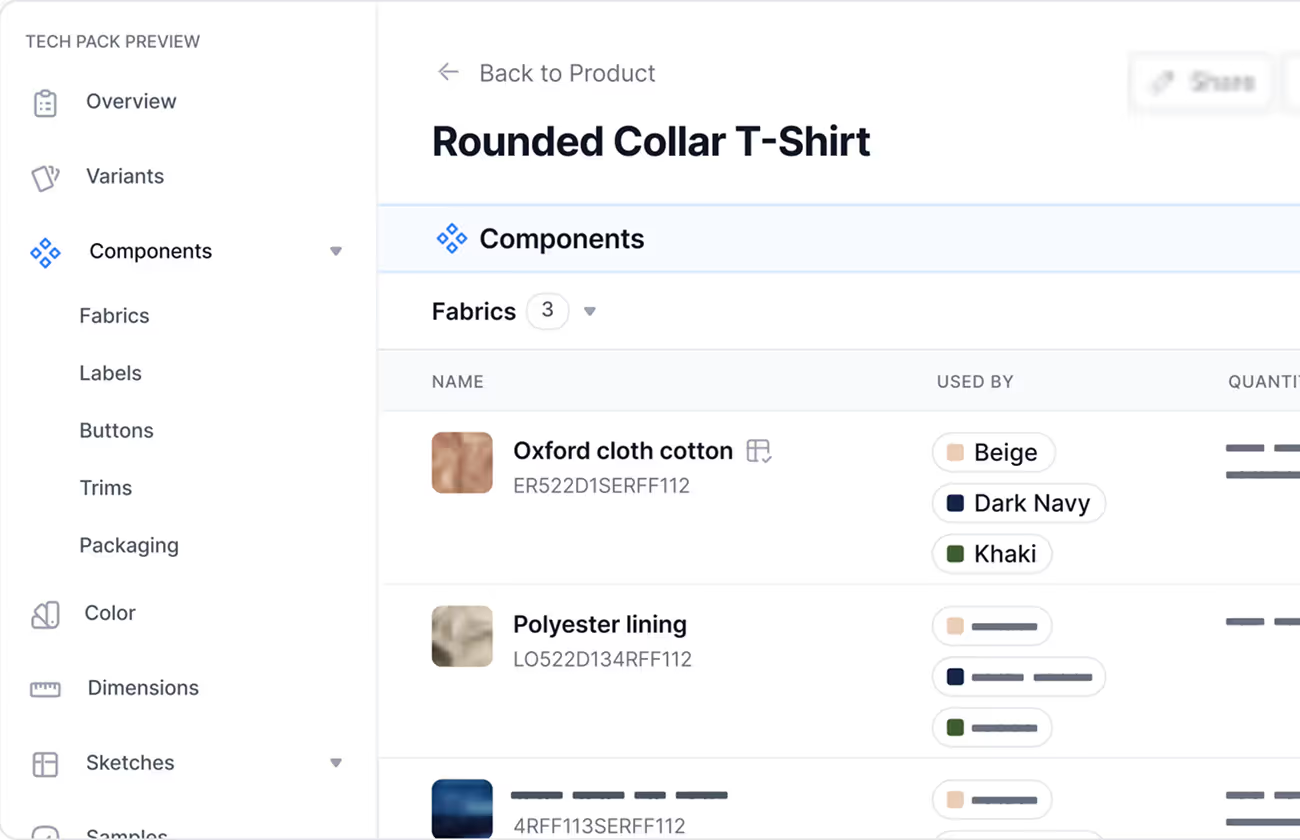
A product's tech pack in Rechain: variants, components (fabrics, labels, buttons, trims, packaging), color, dimensions, sketches and samples listed down the side, with the fabrics and the colorways that use each one
Where an imported style lands: one tech pack in Rechain with its variants, components, colors, dimensions, sketches and samples, and every fabric tied to the colorways that use it.

What should you move first?

Move the season you're developing now and the one after it: those styles and their tech packs, BOMs, components such as fabrics, trims and labels, colors, and the suppliers who make them. That's the data your team opens every day, and it's where Angel's Face started.

Closed seasons can come later or stay in an export. You can decide that after you're live. Finisterre chose to bring eight years of history across from Backbone. Clean what you move while it's being mapped: fix the duplicate color names and the half-filled BOMs in the season you're bringing over, and leave old seasons as they are.

What does your team do during the switch?

Our team does the import. Yours does four things only you can do:

  1. Pick the season. Name the season that moves and the styles in it, so nobody imports a collection that already shipped.
  2. Gather the files. Tech packs in whatever form they're in (spreadsheets, Illustrator files, PDFs or an export from your old PLM), BOM sheets, your fabric and trim lists, and your supplier contacts.
  3. Name one person for questions. Usually your head of product or a senior product developer: someone who can say which of two color names is right without asking around.
  4. Check the first styles. Open a few imported styles next to the originals, including one with a colorway change, before the rest of the team starts working in them.

Then the team works on real styles from day one. ORORO's founder, Mark, was comfortable in Rechain within a couple of days. Stephanie S., a senior product developer, put it this way: "The transition from our previous system took a couple of weeks, and all of our data was properly migrated."

What happens to samples already in progress?

Don't move a style halfway through a fit round. Let the season that's in production or late sampling finish where it is, and start the next season's development in Rechain. Keep your old system's logins until the last style from that season ships, so anyone can still look up a spec. For a brand shipping Spring/Summer while it develops Fall/Winter, a December switch looks like this:

An example switch in December. Only the season in development moves; the season in production finishes where it started.

How do you get your factories onto a new PLM?

The usual worry is that suppliers won't take another login. On Rechain, supplier accounts are free, and suppliers work in their own portal with no training needed. Invite the factories making the season you moved, starting with the ones sampling now, so the next comment on a sample lands in Rechain instead of an email thread.

Get your own team working first, then bring suppliers in. Angel's Face did it in that order: once its team was set up, it started onboarding suppliers to share tech packs and feedback.

Switching from Backbone?

Backbone has been part of Bamboo Rose since 2023. Bamboo Rose still supports it for existing customers, but it points new buyers to its TotalPLM product. NAMA left Backbone after the acquisition, when pricing moved to enterprise minimums. Our import copies your products, components, colors and seasons straight out of Backbone, so nobody on your team retypes them. Finisterre came over from Backbone too, with eight years of historical data, and set up its NetSuite connection. The rest is in Backbone vs Rechain.

What should you ask a vendor before you sign?

  1. Who on your side does the import, and what does it cost? Get the answer in writing, with what's in scope: products, components, orders, old seasons. At Rechain, our team does it, for free.
  2. Can we see the migration plan before the contract? What gets imported, in what order, and the date our team starts working in the new system. A vendor that can't write that plan before you sign is guessing at it after. Ours comes from one of our experts.
  3. What does a supplier pay, and what do they have to learn? On Rechain, nothing and nothing: supplier accounts are free and need no training.
  4. What happens if it doesn't work out? Every Rechain plan has a 60-day money-back guarantee.
Frequently Asked Questions

How much does it cost to switch fashion PLM?
At Rechain, the migration itself is free: our concierge team moves your products, components and orders. You pay for the plan. Business is $99 per user per month paid annually or $120 paid monthly. Every plan is a 12-month commitment with a 60-day money-back guarantee, and supplier accounts are free.
Will our ERP still work after we switch PLM?
Yes. Rechain sends finished product data, BOMs and cost sheets to NetSuite and the same data to ApparelMagic, and other ERPs can connect through Rechain's open REST API. Finisterre set up its NetSuite connection when it moved from Backbone.
What is PLM migration?
Moving your product data, meaning styles, tech packs, BOMs, materials and trims, colors and supplier records, from spreadsheets or an old PLM into a new one, then moving your team and factories over to work there.
More from the blog
View all
No items found.
Best PLM Software for Footwear Brands: 15 Compared (2026)
Matthias Richard
No items found.
Fashion PLM vs ERP in 2026: Which Comes First?
Partnership
Product
Update
The Ultimate Guide To Tech Packs
Matthias Richard

Boost your productivity. Start using Rechain PLM today

Get a personalized demo and see how Rechain PLM can help you manage your product development and production processes.

November 26, 2026
Resources

Fashion PLM Migration: How Long It Takes and Who Does It

What four brands moved to Rechain, who did the import and how long it took, plus what to do with samples already in progress.
Matthias Richard
Matthias Richard

A fashion PLM migration takes weeks, not quarters, when two choices go right: the vendor's team does the import, and you move the season you're developing before anything else. That's how our customers switched to Rechain. Vitality was working two weeks after signing, and Snuggs and Angel's Face were running within a month.

How long does a fashion PLM migration take?

Here's what four brands moved to Rechain, what they moved from, and how long it took. Two of them came from spreadsheets, not another PLM.

BrandMoved fromWhat moved firstWho did the importHow long
Bridge & BurnBackboneIts Backbone dataMatthias Richard, our founderOne weekend, against the two to three weeks the team had planned
VitalityA PLM whose onboarding dragged from October to May or JuneIts existing dataRechain's teamWorking two weeks after signing
SnuggsTech packs in Google Sheets, development tracked in AsanaAll its existing tech packsImported during onboardingRunning within a month
Angel's FaceEmail and Excel100 styles in developmentRechain's teamTeam onboarded in a month

Enterprise PLMs run on a different clock. Centric's own press releases put recent fashion go-lives at three months for Hana Fashion, seven months from kickoff for INUIKII, and eight months for the first phase at Gürmen Group. Those count a rollout, so they don't compare to an import time. They show what "implementation" means at that end of the market: a project plan with phases.

For a brand doing $10M to $200M a year, two choices set the timeline: who does the import, and which season moves first.

Who does the import: you or the vendor?

Ask this before you ask about features. Some vendors send you a spreadsheet template to fill in, and your product developers do the import between fittings. At Rechain, our concierge team migrates your products, components, orders and more, for free. You tell us what you have, one of our experts sends you a migration plan with what to expect, and we let you know when your account is ready for a walkthrough.

Coming from spreadsheets is the same job as coming from another PLM. Angel's Face's first 100 styles came out of email and Excel. Destira's 300 tech packs were Illustrator files. "Onboarding was amazing. Rechain took care of importing all the data we had," Destira's team told us.

A product's tech pack in Rechain: variants, components (fabrics, labels, buttons, trims, packaging), color, dimensions, sketches and samples listed down the side, with the fabrics and the colorways that use each one
Where an imported style lands: one tech pack in Rechain with its variants, components, colors, dimensions, sketches and samples, and every fabric tied to the colorways that use it.

What should you move first?

Move the season you're developing now and the one after it: those styles and their tech packs, BOMs, components such as fabrics, trims and labels, colors, and the suppliers who make them. That's the data your team opens every day, and it's where Angel's Face started.

Closed seasons can come later or stay in an export. You can decide that after you're live. Finisterre chose to bring eight years of history across from Backbone. Clean what you move while it's being mapped: fix the duplicate color names and the half-filled BOMs in the season you're bringing over, and leave old seasons as they are.

What does your team do during the switch?

Our team does the import. Yours does four things only you can do:

  1. Pick the season. Name the season that moves and the styles in it, so nobody imports a collection that already shipped.
  2. Gather the files. Tech packs in whatever form they're in (spreadsheets, Illustrator files, PDFs or an export from your old PLM), BOM sheets, your fabric and trim lists, and your supplier contacts.
  3. Name one person for questions. Usually your head of product or a senior product developer: someone who can say which of two color names is right without asking around.
  4. Check the first styles. Open a few imported styles next to the originals, including one with a colorway change, before the rest of the team starts working in them.

Then the team works on real styles from day one. ORORO's founder, Mark, was comfortable in Rechain within a couple of days. Stephanie S., a senior product developer, put it this way: "The transition from our previous system took a couple of weeks, and all of our data was properly migrated."

What happens to samples already in progress?

Don't move a style halfway through a fit round. Let the season that's in production or late sampling finish where it is, and start the next season's development in Rechain. Keep your old system's logins until the last style from that season ships, so anyone can still look up a spec. For a brand shipping Spring/Summer while it develops Fall/Winter, a December switch looks like this:

An example switch in December. Only the season in development moves; the season in production finishes where it started.

How do you get your factories onto a new PLM?

The usual worry is that suppliers won't take another login. On Rechain, supplier accounts are free, and suppliers work in their own portal with no training needed. Invite the factories making the season you moved, starting with the ones sampling now, so the next comment on a sample lands in Rechain instead of an email thread.

Get your own team working first, then bring suppliers in. Angel's Face did it in that order: once its team was set up, it started onboarding suppliers to share tech packs and feedback.

Switching from Backbone?

Backbone has been part of Bamboo Rose since 2023. Bamboo Rose still supports it for existing customers, but it points new buyers to its TotalPLM product. NAMA left Backbone after the acquisition, when pricing moved to enterprise minimums. Our import copies your products, components, colors and seasons straight out of Backbone, so nobody on your team retypes them. Finisterre came over from Backbone too, with eight years of historical data, and set up its NetSuite connection. The rest is in Backbone vs Rechain.

What should you ask a vendor before you sign?

  1. Who on your side does the import, and what does it cost? Get the answer in writing, with what's in scope: products, components, orders, old seasons. At Rechain, our team does it, for free.
  2. Can we see the migration plan before the contract? What gets imported, in what order, and the date our team starts working in the new system. A vendor that can't write that plan before you sign is guessing at it after. Ours comes from one of our experts.
  3. What does a supplier pay, and what do they have to learn? On Rechain, nothing and nothing: supplier accounts are free and need no training.
  4. What happens if it doesn't work out? Every Rechain plan has a 60-day money-back guarantee.