.png)
TL;DR:
The global PLM market is growing at 7.95% a year through 2030, but that number only really makes sense when you step inside a fashion product team on deadline. This is where ideas take shape quickly, samples come back sooner than expected, and small mistakes turn into expensive problems before anyone can stop them.
One wrong tech pack version gets sent to a factory. A detail gets lost in a 40-email thread. Someone updates a fabric spec but forgets to flag it. Suddenly, the sample comes back completely different, and production timelines start slipping before anyone even notices. That’s the reality of product development at scale, and why spreadsheets eventually stop helping.
That’s exactly why PLM software has become essential for modern fashion brands. But not every system fits every workflow. This guide discusses the best fashion PLM software in 2026 and which ones actually match your team’s needs.
What Fashion PLM Software Is
PLM stands for Product Lifecycle Management, and in fashion, it simply means a single system that keeps all product information, styles, tech packs, BOMs, samples, and costing organized from first concept to final production. It removes scattered files and keeps everyone working from the same source of truth. Unlike generic PLM tools built for industries like automotive or manufacturing, fashion PLM is designed for colorways, size runs, seasonal drops, and constantly changing supplier relationships.
Why Fashion Brands Need a Fashion-Specific PLM
When teams rely on a mix of spreadsheets, inbox threads, and disconnected tools, things start slipping through the cracks fast. McKinsey found that digital and analytics leaders in fashion consistently outperform competitors in total shareholder returns. In practice, that advantage comes down to operational control, knowing exactly what is happening with every product at every stage.
What tends to break when brands rely on scattered tools:
- Duplicate data entry: The same spec lives in four places, and nobody is sure which one the factory has
- Supplier miscommunication: Tech packs get buried in email threads, and factories build from the wrong attachment
- Missed deadlines: No visibility into sample status means delays stack up before anyone notices
- Manual admin: Hours go to copying data between files instead of actually building the product
A fashion PLM puts everything in one place. One version. No guessing.
Must-Have Features in a Fashion PLM
When evaluating fashion PLM software, prioritize features that align with how your product team works day-to-day. The list below covers what actually matters in practice, covering the most needed fashion PLM features that not every vendor will mention on a demo call.
Tech Pack Creation and Export
Tech packs are the core deliverable for communicating with factories. A strong PLM lets teams build them from reusable templates and export instantly as PDF or Excel. This means no more manual formatting headaches and no more messy files. Factories just get clean, complete, and consistent specs every time.
Centralized BOMs, Measurements, and Colorways
A BOM (Bill of Materials) lists every fabric, trim, and component that goes into a product. When BOMs, measurements, sketches, and colorways are kept in one system, everyone finally works from the same version instead of chasing different files. It cuts down the confusion that usually leads to sample mistakes and back-and-forth corrections.
Sample Requests and Review Workflows
Email chains are where sample feedback usually gets lost or delayed. PLM systems bring all sample requests, approvals, and comments into one place. Teams can mark up sample images, tie notes directly to construction details, and see exactly where each style stands in the approval process. This keeps things clear, accountable, and much easier to follow from start to finish.
Costing Scenarios and History
Fashion costs rarely stay the same from development to production. Teams using PLM tools can build multiple costing versions for each style while keeping a clear record of every update over time. The result is stronger margin control and a clear view of when and why costs changed over time.
Supplier Collaboration with Free Partner Access
Paid supplier accounts kill adoption. Factories that face a complicated login process will just email you instead. Free partner access means suppliers can view specs, flag issues, and update progress directly inside the platform. No attachments. No buried threads.
Line Planning and Assortment Tools
Static spreadsheets and live product development do not mix. These tools connect size curves, buy plans, and OTB forecasts directly to styles in development. Your merchandising view stays tied to what is actually moving, not a file someone updated last month.
Integrations with Illustrator, 3D, and ERP
Your team already uses Adobe Illustrator, CLO 3D, NetSuite, and SAP. A good fashion PLM connects to these rather than replacing them. Product data stays consistent from the first sketch through to finance without anyone re-entering the same thing twice.
Security and Digital Product Passport Compliance
The EU Digital Product Passport is already a requirement for brands selling into European markets. SOC 2 and GDPR compliance protect your supplier and materials data while keeping the documentation process inside your existing workflow, not bolted on separately.
Top Fashion PLM Software for Apparel and Footwear Brands
These are the leading fashion PLM software platforms in 2026, organized by use case. The right platform for a 12-person DTC brand looks very different from that needed by a global retailer managing 40 private-label lines. Knowing where your brand stands shapes which platform actually fits your needs.
Rechain
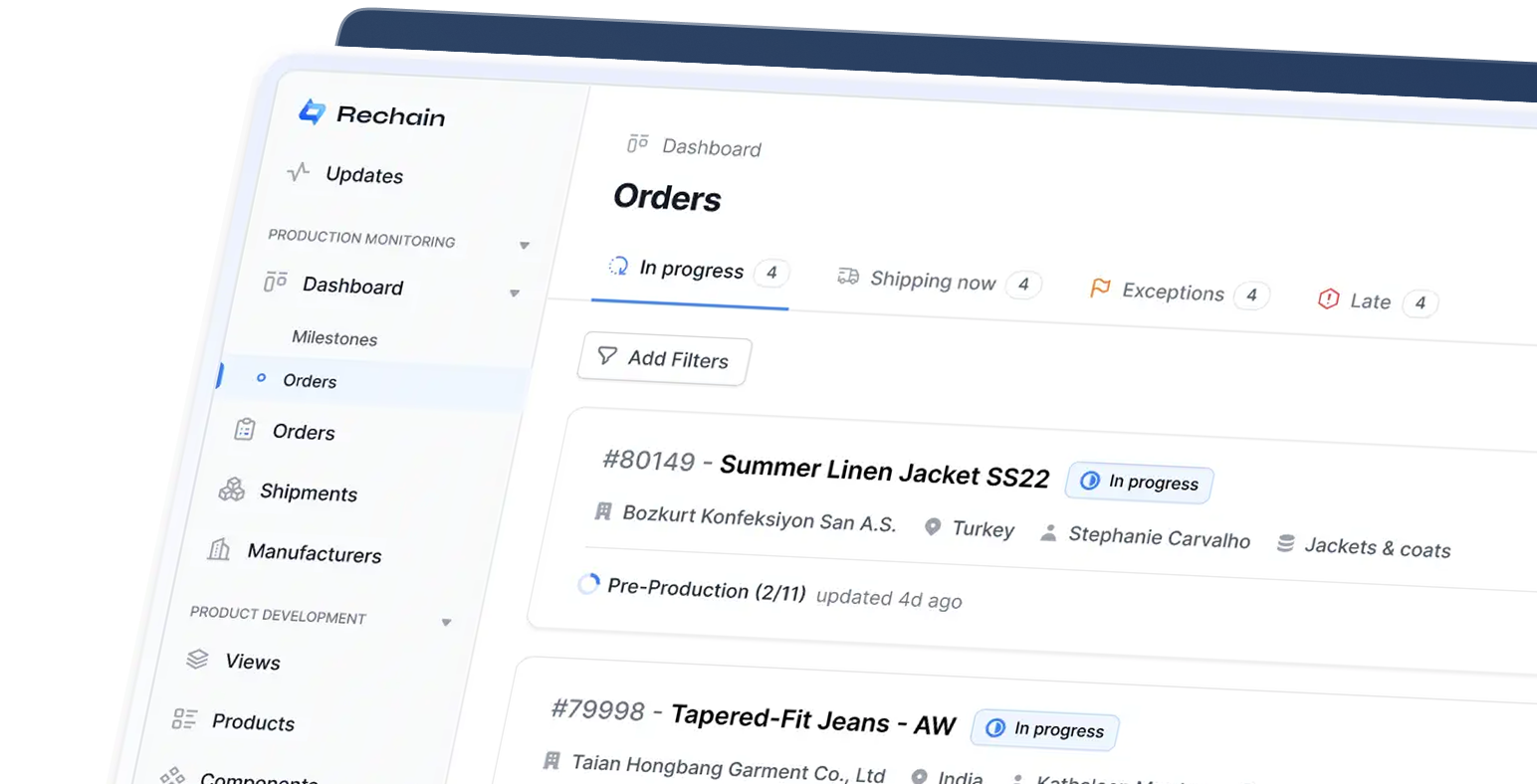
Built as an all-in-one platform for small to mid-sized apparel and footwear brands, Rechain covers the full product lifecycle, from AI-supported design to production tracking and quality control. It is designed for quick setup, easy day-to-day use, and helping teams move off spreadsheets without heavy implementation cycles. Concierge data migration and free supplier access simplify onboarding for both internal and external partners.
- Best for: Growing brands replacing spreadsheets or legacy PLM systems
- Key strengths: Tech pack creation, sample review workflows, supplier collaboration, Digital Product Passport support
- Standout: Free supplier accounts, SOC 2 Type 2, and GDPR compliance
Centric PLM
Built for organizations where product complexity is genuinely large. Multiple teams, global operations, high-volume collections. If you have dedicated PLM admin staff, this is the level of system they are built to run.
- Best for: Large enterprises with 500+ staff and high-volume collections
- Key strengths: Advanced merchandising, AI-driven planning, extensive configurability
- Consideration: Longer implementation timelines and higher overall cost
BlueCherry PLM
For brands that want PLM and ERP talking to each other natively, not through a connector someone built two years ago. Costing, materials, and manufacturing all sit inside one system.
- Best for: Brands needing tight ERP integration and in-depth cost management
- Key strengths: Native ERP connection, colorways, size runs, fabric libraries
- Consideration: Works best for brands already within the CGS ecosystem
PTC FlexPLM
Enterprise retail at scale, with material management at the center. The supply chain visibility is detailed. So is the implementation.
- Best for: Enterprise retail with complex supply chain requirements
- Key strengths: Material libraries, color management, supply chain collaboration
- Consideration: Enterprise pricing and implementation scope
WFX PLM
PLM, ERP, and manufacturing execution from one vendor. Skims, Everlane, and Belstaff use it. Works well for brands sourcing across multiple countries who want fewer vendor relationships to manage.
- Best for: Small-to-medium brands with complex global sourcing
- Key strengths: Supplier portal, multi-country sourcing support, production tracking
- Consideration: Some workflows may require customization
Backbone PLM
Clean interface, fast setup, design-led workflow. Now part of Bamboo Rose following a 2023 acquisition. Good fit for teams getting organized for the first time, less so for brands with serious production and QC needs.
- Best for: Growing brands valuing ease of use over deep customization
- Key strengths: Clean interface, design collaboration, fast implementation
- Consideration: Limited depth for production and QC workflows
BeProduct
Centers the creative side of product development. Visual collaboration tools, cloud-based, built around how design teams think. For brands where production complexity is lower, it covers the workflow well.
- Best for: Design-led brands emphasizing creative collaboration
- Key strengths: Visual interface, collaboration tools, cloud-based access
- Consideration: May need additional tools for production management
Gerber YuniquePLM
The integration with Gerber AccuMark is the reason to choose this. Pattern data, marker information, and material libraries all flow between the two systems. Outside the Gerber environment, that case gets harder to make.
- Best for: Brands already using Gerber cutting and pattern systems
- Key strengths: Gerber ecosystem integration, tech pack software management
- Consideration: The interface feels dated compared to newer alternatives
DeSL PLM
Configurable enough to handle apparel, footwear, and accessories under one system. Useful for multi-category brands where a rigid workflow does not fit every product type. Implementation scope varies depending on how much configuration your setup actually needs.
- Best for: Multi-category brands across apparel, footwear, and accessories
- Key strengths: Configurable workflows, costing tools, supplier management
- Consideration: Implementation complexity depends on the configuration scope
Techpacker
Not a full PLM. Does not try to be. For freelance tech designers and indie brands managing small collections, it is the most practical starting point by a distance.
- Best for: Freelancers and very small teams with simple needs
- Key strengths: Easy tech pack creation, low cost, quick setup
- Consideration: Limited functionality beyond tech pack workflows
Fashion PLM Comparison Chart
Take a look at this quick comparison of the best fashion PLM software.
How to Choose the Best Fashion PLM for Your Brand
The best PLM for fashion brands that fits your workflow depends on your team size, workflow needs, and where you plan to be in two years. Get clear on these five things before you book a single demo.
Match the Platform to Your Brand Size
Enterprise platforms like Centric and PTC FlexPLM need dedicated IT staff and PLM admin headcount to run properly. If you are a 15-person brand, that is not your reality. PLM for small fashion brands such as Rechain, Backbone, and Techpacker suits teams that need fast setup, not a six-month configuration project.
Prioritize the Workflows You Run Every Day
Write down the three things your team does most: tech pack creation, sample tracking, supplier communication, and costing reviews. Match those against what each platform actually does well. A DTC-only brand does not need wholesale buyer portals.
A vertically integrated manufacturer does not need the same things as a pure design studio. Stop trying to find one platform that does everything. Find the one that does your things well.
Weigh Implementation Speed and Customer Support
Enterprise PLMs take 6 to 12 months to implement. Some take longer. Modern cloud platforms go live in weeks.
Ask every vendor for their median implementation time, not their highlight reel. And ask what support looks like during migration, not just after. The answer tells you a lot.
Confirm Factory and Supplier Access
Free supplier accounts reduce friction across your factory network. Paid supplier seats add cost that grows with your supplier list.
Before signing anything, confirm exactly how your suppliers will access the platform and what that will cost in year two. Year-two pricing matters more than year-one pricing.
Check Security, Compliance, and Data Ownership
Selling into EU markets means Digital Product Passport compliance is not something you can defer. SOC 2 Type 2 and GDPR certification matter. And ask the blunt question: who owns your data if you leave? Most vendors will answer vaguely unless you push.
Fashion PLM Pricing and What to Expect
Pricing varies more than most brands expect when they start evaluating some of the best fashion PLM software for apparel. Here are the models you will encounter:
- Per user per month: The most transparent model, common among SMB-focused platforms
- Tiered plans: Freelancer, Business, and Enterprise tiers with increasing features and seat limits
- Enterprise contracts: Annual agreements with custom pricing based on user count and modules selected. Centric, BlueCherry, and FlexPLM all work this way.
- Supplier access costs: Some platforms include supplier seats at no cost. Others charge per account. If you have 10 factories, do the math before you commit.
Most enterprise platforms require a demo call before they share any numbers. Build that into your evaluation timeline so it does not slow you down.
Migrating from Excel or a Legacy PLM
The most common reason brands stay on spreadsheets longer than they should is fear of migration. The assumption is that moving years of product data into a new system will be a months-long project that falls apart.
It does not have to be. Modern PLM platforms have built migration into the onboarding process. Rechain, for example, offers a concierge migration in which your products, components, and orders are moved into the system as part of setup. Your team starts on day one with real data, not a blank system they have to populate themselves.
For brands moving off a legacy PLM, the process is similar. Data gets exported, mapped, and brought across. Most migrations finish in days or weeks. When you are on demo calls, ask directly: what do you handle, and what does my team have to do? That answer separates vendors who have done this many times from those who will hand you a spreadsheet and a help article.
Modernize Product Development with Rechain
Rechain is one of the best fashion PLM software solutions built for apparel and footwear brands managing product development across tools that were never designed to work together.
Whether you are working out of spreadsheets or a legacy system your team has outgrown, Rechain brings your full product development workflow into one place. Design, tech packs, sampling, production, quality control. All connected.
- Centralize product data from design through production and quality control
- Create and share tech packs in minutes, not hours
- Collaborate with suppliers through free partner accounts
- Stay compliant with Digital Product Passport requirements
- Migrate from legacy systems with concierge support
Join 100+ brands already using Rechain to manage their product development. Every account includes a 60-day money-back guarantee, priority support, and white-glove onboarding.
Book a demo to see if Rechain fits your product development workflow.